The Coercive Sequence: How Trump’s Iran War Actually Works
Why negotiation and war are part of the same strategy and what critics still fail to see

The Misreading of the War
In recent weeks, much of the media commentary on the Iran war has followed the same line. Trump, we are told, entered the conflict without a strategy. His goals are unclear. The Islamic Republic is still functioning. It is still firing missiles. Its leaders are still speaking in the language of defiance. Therefore, the argument goes, the United States must be failing. Much of the commentary has described the war as lacking a plan, marked by confusion over its aims, and driven by shifting goals. Some have gone further, arguing that even an American victory over Iran would be bad for the United States and for the wider world.
This reading is wrong. The war is not the absence of strategy. It is coercive diplomacy: terms first, pressure second, pause third, then renewed pressure from a stronger position.
To judge the war only by missile launches, angry speeches, and the continued movement of a battered regime is to miss the larger picture. What critics call a war without a strategy is, in fact, an attempt to end twenty years of failed policy.
The Logic of Coercion
For two decades, Washington tried different ways to stop the Islamic Republic’s nuclear advance. Some administrations leaned more on sanctions. Others leaned more on diplomacy. Some tried both. Yet through all of it, the Islamic Republic moved from zero enrichment to 60 percent. By June 2025, the IAEA said Iran had 440.9 kilograms of uranium enriched to that level, enough for multiple nuclear bombs if enriched further. At the same time, the IRGC’s missile stockpile grew, its range and destructive power increased, and those capabilities spread to proxies from Lebanon to Iraq and Yemen. That was the result of the old approach.
The war has costs for the United States, politically and financially. But inaction was costlier. Washington began negotiating with Iran when enrichment was at 3 to 5 percent. It was still negotiating two decades later, after that level had reached 60 percent. By then, from a technical point of view, reaching weapons-grade material was no longer a scientific hurdle. It was a political decision. For years, diplomacy was politically and financially preferable to war. But there was no longer another twenty-year window. Iran was a nuclear-threshold state, shielded by a large missile arsenal and aligned with China and Russia. And Iran is not North Korea. It sits in the middle of the world’s most strategic region, close to major energy routes, trade corridors, and American allies. Its weaponisation would have carried far wider consequences. The price the United States is paying now is heavy. But it is still far less than the political, economic, and geopolitical price it would have paid for allowing the Islamic Republic to harden into an entrenched nuclear-threshold power.
The war has costs for the United States. But inaction was costlier.
Trump’s answer was different. He was no longer trying to manage the problem or secure another temporary arrangement. After returning to office in January 2025, he demanded rollback: an end to enrichment, limits on the missile programme, and the dismantling of the proxy network through which the Islamic Republic had built regional power. Tehran refused, as it had through two decades of diplomacy and negotiation. The result was a shift from bargaining to attrition. The regime began to lose, by force, the very instruments through which it had built deterrence and projected power. In that sense, coercion was producing the rollback that diplomacy had failed to secure.
The 12-day war began in June 2025, after diplomacy failed and Israel struck the Islamic Republic’s nuclear and military infrastructure. The attack came at the end of a two-month negotiating window set by Trump. It marked the shift from coercive diplomacy to open war.
Trump stopped the war after twelve days. That pause, too, was part of the strategy. The June war did not target the political leadership. It was meant to shock the regime and force a choice, while giving its political leaders time to assess the damage and decide whether saving the system now required giving up some of its strategic assets.
That did not happen. A few months later, negotiations resumed, but within the same coercive framework. They were not a fresh search for compromise. They were another attempt to force acceptance of the same core demands.
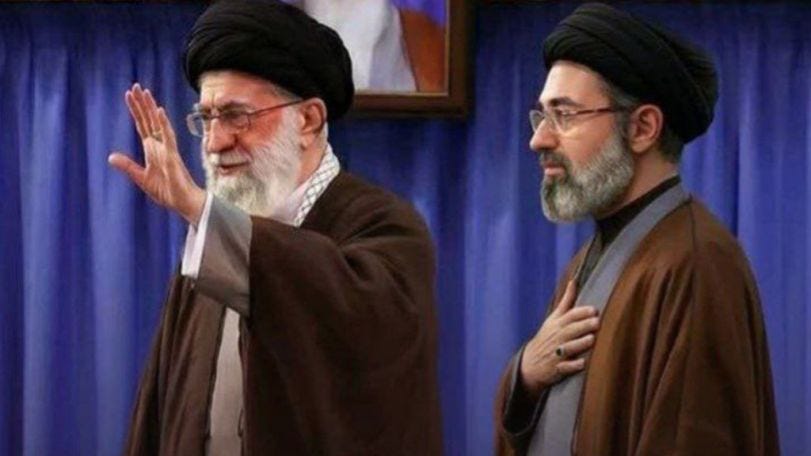
Ali Khamenei rejected those terms again and was killed in the opening moments of the second war. This followed the same logic. If Khamenei himself was the main barrier to surrender, then removing him could create space for others inside the system to accept what the Islamic Republic had long refused.
But the regime remained defiant. Seventeen days after Khamenei’s death, Ali Larijani, another senior political figure, was also killed. Now, Ghalibaf’s name is being floated as the man who could be pushed to accept those demands. But the deeper reality is that Ghalibaf is not the man calling the shots in Iran today. Nor was Larijani. After Khamenei, no one is fully in command. This, too, is a sign of a system struck at the centre and beginning to unravel.
The administration’s refusal to recognise Mojtaba Khamenei, along with Trump’s dismissal of him as “a lightweight” who would be “unacceptable” as Iran’s leader, is part of the same coercive sequence. By denying him legitimacy from the outset, Washington is floating names, testing possibilities, and searching for someone within the regime willing to sign. At the same time, the regime’s nuclear, missile, naval, and proxy assets, together with the wider military machinery on which its regional power depended, are being steadily degraded. The Islamic Republic still has a choice: relinquish what remains by agreement, or lose it by force.
Negotiation and war are not opposites. They are successive phases of the same campaign.
This is the point many critics miss. In Trump’s approach, negotiation and war are not opposites. They are successive phases of the same campaign. Negotiation presented the terms. Force raised the cost of refusal. The pause tested whether the strikes had altered the regime’s calculations. Negotiation then resumed from a position of greater pressure. That is not incoherence. It is strategy.
The End of the Old Status Quo
Whatever happens next, Trump has already changed the strategic picture. If this war ends with the fall of the Islamic Republic, he will have secured a historic victory. If the regime survives, it will survive in a diminished form. In less than a month, Washington has already achieved what twenty years of negotiations did not: an Islamic Republic with its nuclear and missile programmes sharply pushed back and its regional reach greatly reduced. Either way, the old status quo is gone.
Two analytical mistakes have made this harder to see.
The first is to mistake visible continuity for strength. In an earlier essay on the Islamic Republic’s collapse plan, I argued that a system can still fire missiles, repress, broadcast, and project fragments of normality after its centre has been hit. None of that proves it is strategically healthy.
The second is to act surprised by escalation. Before the war, I described the Islamic Republic’s logic as deterrence through escalation. Anyone who thought the regime would collapse through decapitation alone misunderstood it. The administration clearly did not make that mistake. That is why it deployed hundreds of tons of ammunition to the region before the war began. Continued missile fire does not prove that Trump has no strategy. It shows that the Islamic Republic has one too: absorb punishment, escalate where possible, and hope that fear, market shock, and regional pressure weaken American resolve before the regime is forced into real surrender.
The very states Iran hoped to intimidate are moving in the opposite direction.
But that strategy has limits. The more the regime threatens shipping, attacks infrastructure, and uses missiles, drones, and proxies as tools of pressure, the more it convinces its neighbours that their own trade, investment, and long-term stability cannot safely coexist with the Islamic Republic as it is. Tehran’s calculation was that regional havoc would frighten neighbouring Arab states into pressing Washington to stop the war. Instead, the logic has begun to reverse. Qatar and Saudi Arabia have declared Iranian diplomatic personnel persona non grata, while the UAE has closed its embassy in Tehran and withdrawn its diplomatic mission. The very states Iran hoped to intimidate are moving in the opposite direction, concluding that its capacity for disruption must be reduced, not accommodated.
So the central argument is simple. Much of the prevailing media reading is wrong because it mistakes visible continuity for strategic success and escalation for surprise. It sees a regime still speaking, still firing, still standing in some form, and concludes that Washington must have no plan. But the plan is visible. Trump appears to have concluded that sanctions, diplomacy, delay, and partial restriction did not stop the Islamic Republic’s nuclear advance. They only slowed it while the programme moved closer to threshold status. His answer was not to manage the problem more carefully, but to try to end it.
One may say this strategy is dangerous. One may say it is too blunt, too risky, or too ambitious. But it is not absent. The question is no longer whether Trump has a strategy. The question is whether the Islamic Republic, under the greatest pressure it has faced in decades, will accept strategic retreat before the cost of refusal becomes existential.
With or without another war, the regime’s days are numbered
The war may continue until the regime falls. It may also pause again, to give Tehran one more chance to accept the terms. But if the regime persists on the same path and tries to rebuild what it has lost, a third war will be hard to avoid. In the meantime, it will face crippling sanctions and a far more hostile region after firing hundreds of missiles and drones at neighbouring states. They will not forget this episode. For two decades, those same states were Tehran’s economic lifeline, tolerating the Islamic Republic’s elaborate sanctions-busting networks and the thousands of front companies through which it kept trade alive. That lifeline is now fraying. The old status quo is gone. With or without another war, the regime’s days are numbered. That is the strategic shift many analysts still fail to see.
Again, a sober analysis.
However, we have two challenges:
The world's mainstream media--and I read them with interest due to factors apart from the Iran war--The Economist, Financial Times, Bloomberg, the New York Times have been characterizing the war as a losing proposition for both the US and Israel. Their narrative is finding adherents as I write this.
The MAGA--The MAGA were not provided with a forceful narrative as to why this war was a necessary war. Why this war was not a "forever" war. In other words, no one even attempted to sell the war to the MAGA infantry.
And now the wild card:
1. The Iranian people--assuming that 85% of the population are either against the regime or at minimum, apathetic--are not given the "agency" role they have richly earned. They came to the streets in late December and were massacred en masse. They are being silent, which is not equal to "being silenced". When your enemy is fighting and getting hammered, you would not wish to interfere in that process. You "bide" your time.
The Extent of the active support of the Islamic Republic:
And now a final word with the people who read Mehdi's substack. Mehdi has gotten a good perspective on the situation. I would like to add a new one, one which is not widely understood and in the process, not discussed.
Anecdotally, one hears that 15% of Iran's population support the Islamic Republic (90,000,000 * 0.15 = 13,500,000) and assuming 0.5% of that figure (13,500,000 * 0.005 = 67,500) is what could be characterized as the "hard core" (this number includes the active revolutionary guard, basij and other armed groups), the US, Israel and subsequently, the armed anti-Islamic Republic can deliver enough damage to render a fraction of the 67,500 immobilized, thus rendering the remaining out of the theater of kinetic activities. Of course, these "cultist" will move to the shadows and engage in terrorism but this can be managed.
What I am arguing is that the path to victory is not uncertain but quite curvy and at times not paved. (asphalt versus dirt road). But Iran, once liberated, will be the biggest seminal event in modern human history, equal to, if not greater, than the collapse of the Berlin Wall? Why? Because with the Berlin Wall, we had the collapse of Communism. With the fall of the Islamic Republic, we will usher the fall of Islamic militancy, which has been gnawing at the world for nearly half a century.
Shining a bright light on the simple truth. Thank you!